
[ home port |
lectures |
labs |
surf |
email profs. ]
Lecture 13
Ocean Surface Currents
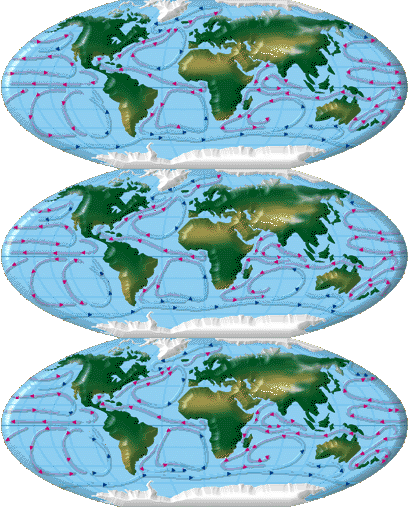
Animation courtesy of D. Reed, San Jose State Geology
Main points of today's lecture:
- Patterns of atmospheric circulation.
- Effects of winds on the surface of the ocean.
- Coriolis effect and Ekman transport.
- Global surface-water current pattern.
Insights:
- As the sun warms up the surface of the earth at the
equator, warm air becomes lighter and rises higher in the
atmosphere where it flows towards the poles, cooling down
and increasing in density. Cooler, heavy air sinks back to
the surface of the planet and thence flows towards the
Equator, creating an atmospheric cell circulation
pattern. Air currents (winds) are sometimes named in the direction FROM
which they come (e.g., "westerlies"). Trade winds are an important wind band
too. Ocean currents are named for the direction
in which they are GOING.
- Winds
are created by air currents flowing in the
atmosphere from high-pressure regions towards
low-pressure ones. Complex global wind patterns
result mainly from the rotation of the Earth and from the
uneven distribution of solar heat on it's
surface.
- Free moving objects traveling on the surface of the
planet experience a deflection in their trajectories, to
the right in the Northern Hemisphere and to the left in the
Southern Hemisphere, due to rotation of the Earth. This
deflection, which increases towards the poles, is called
the Coriolis effect. The Coriolis effect is significant only for large distances and long time scales. Remember that it is an "apparent" force, not a real force like gravity.
- Winds blowing across on the surface of the ocean make the
water move. Water currents being dragged along by the
winds will deflect to the right, due to the Coriolis
effect; movement of these currents will drag the water
particles immediately beneath them, which will also deflect
to the right. This pattern repeats itself downward,
creating a spiraling current whose speed decreases with
depth, called the Ekman spiral.
- Circulation gyres
are gigantic ocean currents
flowing in circular trajectories from East to West along
the Equator, towards the poles at the western ends of the
ocean basins, to the east in the polar regions, and towards
the Equator along the eastern boundaries of the ocean
basins, where the cycle repeats again.
Other goodies
Antarctic circumpolar current
- no land masses blocking
- tremendous wave activity there
Edges of basins are where currents are strongest, especially on the western side of the basin (e.g., Gulf Stream going up the western Atlantic)
Sverdrup
- 1 Sv is all the water in all of the world's rivers!
- Imagine 55 million cubic meters of water flowing past you!
- That's the Gulf Stream (55 Sv)!
Does water just follow the wind?
- No! See above on Ekman transport. Surface currents are driven by the wind but also by Ekman transport
- Ekman was a graduate student for Nansen and was charged with figuring out why icebergs always moved to the RIGHT of the wind up in the Arctic Sea.
Mounds
- the "mound" in the middle of ocean gyres is maintained by a balance between the Coriolis force and the pressure gradient (aka geostrophic flow)
- related to that, westward intensification of ocean boundary currents is maintined by the Coriolis force
Upwelling is the key to phytoplankton happiness and productivity!
Biggest waves on the planet found at the southern tip of Africa
- large freighters broken up by these waves
- phenomenal surf and surfers
Trash from 2011 Japanese tsunami
- estimate is that it will take 2 years to get from Japan to US west coast
(730 days)
- some of it will sink
- a lot of it will be dispersed throughout the gyre
- so we will NOT have piles of trash from Japan appearing on our beaches
Have you thought about...? (answers need not be
submitted!)
- What's the role of the ocean in the atmospheric weather
pattern?
- Does the rotation of the earth affect a boat sailing
from Seattle to Hawaii?
- Why is the ocean water always so cold on the Oregon
coast?
[ home port |
lectures |
labs |
surf |
email profs. ]
http://dusk.geo.orst.edu/oceans/surface_currents.html